

Choosing a bed pillow sounds simple until you start comparing loft, firmness, foam density, cooling covers, and a dozen different filling materials.
My starting point is much simpler: the right pillow should support your head and neck comfortably without forcing them into an awkward angle.
That does not automatically mean choosing the firmest pillow, the thickest pillow, or the most expensive one. A pillow that suits a broad-shouldered side sleeper on a firm mattress may feel completely wrong for a back sleeper on a softer bed.
If you’re wondering How to Choose the Right Bed Pillow, I recommend working through five factors:
- Your usual sleeping position.
- The pillow’s height after your head compresses it.
- Your mattress and body proportions.
- Your preferred material and feel.
- The opportunity to test the pillow and return it if necessary.
This guide focuses on adult bed pillows and explains how I would use those factors to narrow the options.

1. Start With Your Sleeping Position
Sleeping position is the most useful starting point because it changes the space your pillow needs to fill.
Here is the basic framework I recommend:
| Sleeping position | Starting point for loft | Main priority |
|---|---|---|
| Side | Medium to high, depending on your build and mattress | Fill the gap between your head and the mattress without tilting your neck |
| Back | Low to medium | Support the neck without pushing the chin toward the chest |
| Stomach | Very low | Limit unnecessary upward bending of the neck |
| Combination | Adjustable or adaptable | Maintain reasonable alignment in your most common positions |
These are starting points, not universal rules. What matters is how the pillow behaves under your head, not just how tall it looks on a shelf.
What Is the Best Pillow for Side Sleepers?
When choosing the best pillow for side sleepers, I would prioritize enough usable height to fill the space created by the shoulder.
A pillow that compresses too much can let the head drop toward the mattress. A pillow that stays too high can tilt the head in the opposite direction.
My side-sleeper checklist would include:
- Enough loft after compression.
- Support that does not collapse easily.
- A surface that feels comfortable around the ear and jaw.
- An adjustable design if the correct height is difficult to judge.
Broader shoulders and a firmer mattress can increase the height you need. However, shoulder width alone is not enough to determine the right pillow because mattress sinkage changes the gap.
For a position-specific comparison, explore the guide to the best pillow for side sleepers.
What Is the Best Pillow for Back Sleepers?
For the best pillow for back sleepers, I would look for a balance between gentle neck support and modest head elevation.
Too much height can push the head forward. Too little support may leave an uncomfortable gap beneath the neck.
I recommend checking whether:
- Your chin feels pushed toward your chest.
- Your head tips backward uncomfortably.
- The pillow supports the neck without forcing a pronounced curve.
- You can relax without repeatedly repositioning the pillow.
A contoured pillow can work for some back sleepers, but the contour still needs to match the person. An “ergonomic” label does not guarantee the correct fit.
The best pillow for back sleepers guide can help you compare suitable shapes and constructions.
What Is the Best Pillow for Stomach Sleepers?
When considering the best pillow for stomach sleepers, I would generally start with a thin, compressible design.
Stomach sleeping already requires the head to turn to one side. A thick pillow may add an uncomfortable upward angle.
Some stomach sleepers prefer no pillow beneath their head, although that is not a universal solution and does not remove the neck rotation associated with the position.
If stomach sleeping regularly causes neck discomfort, I would not assume that changing pillows is the entire answer. It may be worth discussing sleeping position and symptoms with a healthcare professional.
For low-profile options, see the best pillow for stomach sleepers guide.
What if You Change Positions Overnight?
For combination sleepers, I would focus on the positions used most often rather than trying to optimize for every occasional movement.
An adjustable-fill pillow can be useful because you can add or remove filling. A responsive pillow may also make repositioning easier than a deeply contoured design.
The goal is a workable compromise—not a pillow that feels perfect in one position and awkward in all the others.
2. Understand Loft, Firmness, and Support
These terms are often treated as interchangeable, but they describe different things.
Loft Means Height
Loft is the pillow’s thickness.
The important distinction is between:
- Uncompressed loft: How tall the pillow looks before use.
- Compressed loft: How much height remains beneath your head.
I care more about compressed loft because that determines the sleeping position the pillow creates.
A tall, soft pillow can compress lower than a thinner, firmer pillow. That is why comparing advertised measurements alone can be misleading.
Firmness Means Resistance to Pressure
Firmness describes how strongly the pillow resists compression.
A soft pillow lets your head sink farther into the surface. A firmer pillow generally allows less sinking, although construction and fill distribution also matter.
I would choose firmness partly for comfort, but always check its effect on head position.
Support Means Maintaining a Suitable Position
Support is the pillow’s ability to hold your head and neck at a comfortable height and angle.
Firmness is not the same as support. A very firm pillow can be poorly suited to you if it holds your head too high. A softer pillow can work well if it compresses to the right height without collapsing.
My rule of thumb is to evaluate loft and firmness together rather than selecting either in isolation.
3. Match the Pillow to Your Mattress and Body Proportions
I would never choose a pillow without considering the mattress beneath it.
On a Softer Mattress
Your shoulders and torso may sink farther into the surface. For a side sleeper, that can reduce the gap the pillow needs to fill.
As a result, a pillow that worked well on a firm mattress might feel too high on a softer one.
On a Firmer Mattress
Your shoulders may remain closer to the surface. That can leave a larger gap between your head and the mattress, particularly when sleeping on your side.
More usable pillow loft may be helpful, but I would still judge the actual sleeping position rather than assume “firm mattress equals thick pillow.”
Consider Your Proportions, Not Just Your Height
Shoulder width, neck shape, and how deeply you sink into the mattress all matter. Two people of the same height can need noticeably different pillows.
This is one reason I favor adjustable options when fit is uncertain: they offer a practical way to fine-tune height rather than relying on a broad “one size fits all” claim.
4. Choose the Right Pillow Material
Once the basic fit is clear, I would compare materials based on feel, responsiveness, maintenance, and temperature comfort.
No filling is automatically best for every sleeper.
Memory Foam Pillow: Contouring and a More Stable Shape
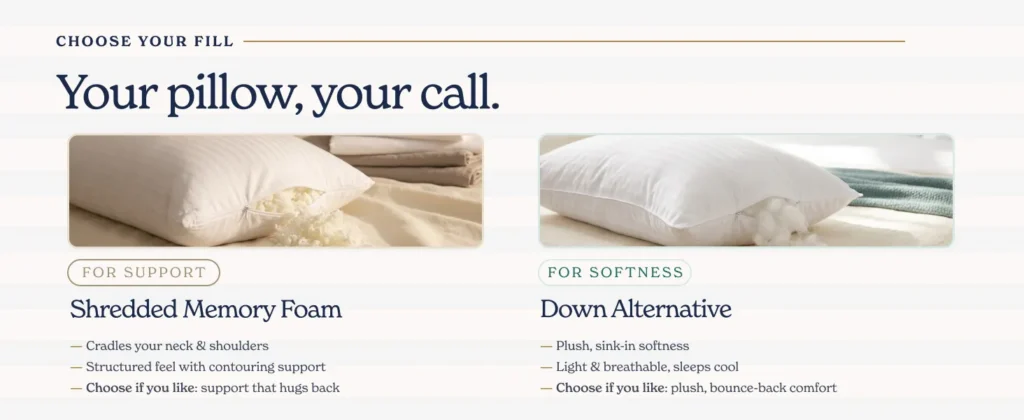
A memory foam pillow generally contours around the head and responds more slowly than springier materials.
I would consider it if you prefer a cradling sensation or want a pillow that maintains a defined shape.
However, construction makes a significant difference:
- Solid memory foam usually has a fixed shape and less height adjustment.
- Shredded memory foam is more moldable and may allow filling to be removed.
- Contoured memory foam has shaped areas intended to support particular positions.
Potential drawbacks include heat retention in some designs and limited cleaning options. Not every foam pillow is suitable for machine washing.
Before buying, I would check whether the loft is adjustable and whether the contour matches the way you sleep.
For a closer comparison, read the memory foam pillow guide.
Latex Pillow: Responsive and Buoyant
A latex pillow typically feels springier and more immediately responsive than memory foam.
Instead of slowly conforming around the head, latex tends to push back more quickly.
I would consider it for someone who:
- Prefers a buoyant rather than deeply cradling feel.
- Changes position frequently.
- Wants a pillow that rebounds promptly after movement.
Latex pillows can still differ substantially in firmness, height, and construction. Solid latex and shredded latex should not be treated as identical products.
If you have a diagnosed latex allergy, ask your clinician whether a latex pillow is appropriate.
The latex pillow guide explains the main construction differences and buying considerations.
Other Common Pillow Fillings
| Filling | Typical feel | What I would check |
|---|---|---|
| Down | Soft, light, and easily shaped | Whether it maintains enough height after compression |
| Feather or down-and-feather blends | Moldable, with a more noticeable filling structure | Comfort, fill distribution, and potential feather poking |
| Down alternative | Often plush; feel varies by fiber and construction | Whether it becomes flat or lumpy, plus washing instructions |
| Buckwheat hulls | Firm, adjustable, and highly moldable | Weight, movement noise, and whether the texture suits you |
I would not choose a filling based solely on a label such as “luxury,” “natural,” or “hotel quality.” Those descriptions do not establish whether the pillow will fit your body.
5. Compare Pillow Sizes Without Confusing Size With Loft
Pillow sizes describe the pillow’s length and width—not necessarily its height or support level.
Common U.S. rectangular bed-pillow dimensions are:
| Size | Typical dimensions |
|---|---|
| Standard | 20 × 26 inches |
| Queen | 20 × 30 inches |
| King | 20 × 36 inches |
Manufacturer dimensions can vary, and specialty-shaped pillows may use different measurements.
A king pillow is not automatically more supportive than a standard pillow. Its extra length may be useful if you move around, but I would still evaluate loft, compression, and firmness separately.
I would also check pillowcase fit. A case that is too tight can compress the filling and change the feel, while a loose case may allow more movement.
For dimensions and bedding compatibility, use the pillow sizes guide.
6. Check Cooling, Allergies, and Cleaning Requirements
These details may not determine initial fit, but they can affect whether the pillow remains comfortable and practical.
Do Not Rely on “Cooling” Labels Alone
I would distinguish between a fabric that feels cool initially and a pillow that manages heat comfortably over several hours.
A cool-to-the-touch cover does not, by itself, prove all-night cooling performance.
Instead, I would consider:
- The cover’s breathability.
- The filling and internal construction.
- Whether the design allows airflow.
- The pillow protector and pillowcase used with it.
- The room temperature and the rest of the bedding.
A gel label alone would not persuade me to buy a pillow.
Treat Allergy Claims Carefully
“Hypoallergenic” is not a guarantee that a pillow will prevent allergy symptoms.
For someone with a dust-mite allergy, I would prioritize an appropriate allergen-resistant encasement and a manageable bedding-cleaning routine rather than relying on the filling’s marketing claims.
The Asthma and Allergy Foundation of America’s dust-mite allergy guidance provides additional information about reducing exposure.
Read the Care Label Before Buying
A washable cover does not mean the entire pillow is washable.
Some fillings tolerate machine washing, while others require spot cleaning or different care. If easy maintenance is a priority, I would check this before making the purchase.
For care methods and common mistakes, see how to wash pillows, and always follow the individual product’s instructions.
7. Test the Pillow Before the Return Window Closes
A few squeezes in a shop cannot tell you how a pillow will feel on your own mattress.
Here is the testing sequence I recommend.
Step 1: Use Your Normal Sleeping Setup
Test the pillow with your usual mattress, protector, pillowcase, and sleeping position.
Those details affect the final feel.
Step 2: Let the Filling Compress
Give the pillow time to settle under your head. Do not judge the fit only from its appearance or the first few seconds of contact.
Step 3: Check Your Head and Neck Position
For side sleeping, look for obvious upward or downward tilting.
For back sleeping, check whether your chin is being pushed toward your chest or your head is tipping backward uncomfortably.
A partner or a photo can help reveal a pronounced angle, but neither should be treated as a medical assessment.
Step 4: Notice Whether You Can Relax
Ask yourself:
- Can I settle without repeatedly folding or stacking the pillow?
- Does my neck feel comfortably supported?
- Is there uncomfortable pressure around my ear or jaw?
- Can I change positions easily?
Step 5: Reassess After Normal Overnight Use
Pay attention to how the pillow feels through the night and on waking.
Do not assume new or worsening pain is something you must “push through.” If a pillow clearly aggravates discomfort, reassess the fit rather than forcing a long adjustment period.
8. Compare Return Policies Before Comparing Luxury Features
I would put a useful sleep trial ahead of an elaborate marketing story.
Before purchasing, check:
- Whether the policy allows returns of used pillows.
- How long the trial lasts.
- Whether return shipping costs extra.
- Whether restocking fees apply.
- Whether sale items are excluded.
- Whether the policy offers a refund or only an exchange.
A warranty and a comfort trial are different. A warranty may address manufacturing defects without covering a pillow that simply feels wrong for you.
When deciding where to spend more, I would prioritize fit, useful adjustability, suitable construction, and a clear return policy—not the highest price tag.
Frequently Asked Questions
Can a Pillow Fix Neck Pain?
A better-fitting pillow may improve comfort, but neck pain can have causes that a pillow will not resolve.
I would treat pillow selection as a comfort decision, not a diagnosis or guaranteed treatment.
If pain persists, worsens, follows an injury, or comes with symptoms such as arm numbness or weakness, seek medical advice rather than continuing to experiment with bedding. For health information, see MedlinePlus’s overview of neck injuries and disorders.
Is a Firm or Soft Pillow Better?
Neither is universally better.
I would choose the firmness that allows the pillow to compress to a comfortable height while maintaining enough support. A firm pillow can be too tall, while a soft pillow can be suitable if it does not collapse excessively.
Are Adjustable Pillows Worth Considering?
Yes—particularly when you are uncertain about the correct loft.
However, I would check what “adjustable” actually means. Some designs allow filling to be removed, while others use removable layers or inserts.
Adjustability helps fine-tune fit, but it does not guarantee that you will like the underlying material.
How Often Should I Replace My Pillow?
I would assess condition rather than rely only on a calendar.
Consider replacement when the pillow:
- No longer maintains useful support.
- Has persistent lumps or uneven filling.
- Cannot be cleaned adequately according to its care instructions.
- Has become uncomfortable despite reasonable adjustment.
- No longer suits a change in mattress or sleeping position.
Different materials and care routines produce different lifespans.
Should I Stack Two Pillows Under My Head?
I would not make stacking the default solution.
Two pillows can create excessive height or an unstable surface. If you routinely need to stack, fold, or bunch your pillow to get comfortable, that may indicate that a different loft or construction would be a better fit.
My Final Pillow-Buying Checklist
Before choosing a bed pillow, I would confirm that:
- The loft suits my usual sleeping position.
- The pillow stays supportive after compression.
- My mattress and body proportions are part of the decision.
- The filling provides the feel I prefer.
- The size works with my bed and pillowcases.
- The cleaning requirements are realistic.
- The return policy allows a meaningful test.
My final recommendation is simple: choose the pillow that fits your sleeping setup, not the one with the most impressive label.
Start with position and alignment, refine the material and comfort features, and use a genuine trial period when possible. That approach is more useful than assuming one pillow design is right for everyone.
